SAPS Police Trainee Programme 2026/27 – 5,500 Posts (R5,000 Stipend)
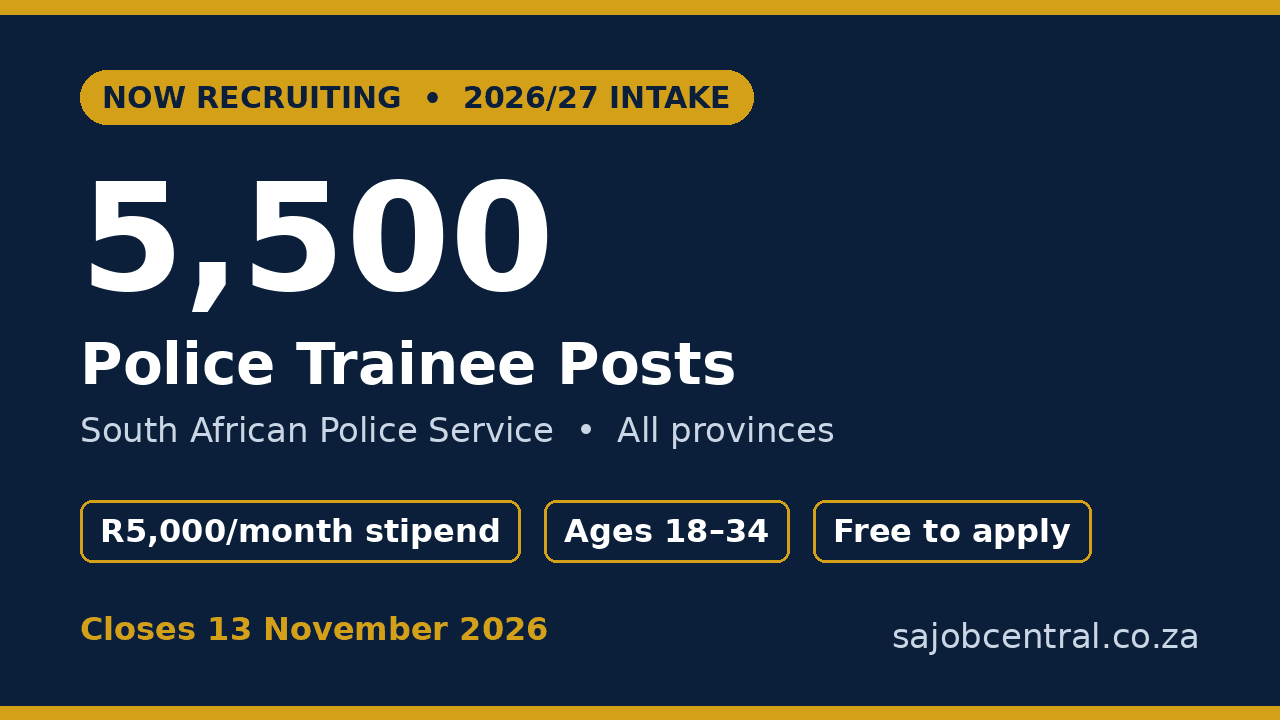
SAPS is recruiting 5,500 police trainees nationwide. Apply free online through the SAPS eRecruitment portal by 13 November 2026.
- Employer
- South African Police Service (SAPS)
- Location
- All provinces, Eastern Cape
- Job type
- Trainee programme
- Salary
- R5,000 per month (stipend)
- Closing date
- Closes 13 Nov
Real employers never ask you to pay to apply. If someone asks for money, report the post to us.
If you have ever pictured yourself in a SAPS uniform, now is the time to act. The South African Police Service has opened 5,500 police trainee posts for its 2026/2027 intake, one of the largest public-sector recruitment drives of the year. The posts are open to young people in every province, trainees are paid a monthly stipend from the day training starts, and applying costs you nothing.
Because so many people apply for these posts, the applicants who get through are usually the ones who prepare properly. This guide takes you through who qualifies, what the training involves, how selection works, how to apply step by step, and how to give yourself the best possible chance.
The SAPS trainee intake at a glance
- Employer: South African Police Service (SAPS)
- Number of posts: 5,500 police trainees
- Location: Nationwide, all nine provinces
- Stipend: R5,000 per month while you train
- Training period: 6 or 9 months, depending on your qualifications
- Age: 18 to under 35
- How to apply: Online, through the official SAPS eRecruitment portal
- Cost to apply: Free
- Closing date: 13 November 2026
Why this intake matters
Youth unemployment remains one of South Africa’s biggest challenges, and few opportunities offer what this one does: a structured training programme, a monthly income during training and a route into a long-term career in the public service. For many young people without a degree, it is a rare chance to enter a stable profession straight after matric. For graduates, it can be a door into specialised investigative work.
A large intake also means a large number of applicants. Treat this as a competitive process: apply early, complete everything carefully, and start preparing for the selection stages now rather than waiting to be shortlisted.
Who can apply
SAPS has published these minimum requirements for the intake:
- You must be 18 or older and younger than 35
- You must have no criminal record
- You must have no criminal case pending against you
SAPS has also said it wants to attract suitably qualified young people from groups that are currently underrepresented in the service, so applicants from those groups are particularly encouraged to apply.
Read the full post description on the eRecruitment portal before you submit. It is the final word on any additional requirements, and it is worth checking carefully so that your application is not rejected on a detail you missed.
A faster route for graduates
This intake is not only for matriculants. If you hold a qualification in Law, Policing, Criminology, Law Enforcement, Forensic Investigation or Information Technology, SAPS may consider you for placement in one of its specialised divisions:
- The Hawks (Directorate for Priority Crime Investigation), which handles serious organised crime, commercial crime and corruption
- Detective and Forensic Services, which covers criminal investigations and evidence work
- Crime Intelligence, which gathers and analyses information to prevent and solve crime
Graduates with a relevant qualification at NQF Level 6 or higher also complete a shorter basic training programme of six months instead of nine. If you have such a qualification, make sure it is clearly captured on your profile so it is taken into account.
Stipend and training
Trainees who are selected attend a SAPS training academy and are paid a stipend of R5,000 per month for the length of the programme.
- Six months for trainees with a relevant NQF Level 6 or higher qualification
- Nine months for all other trainees
Academy life is demanding. Police training generally combines classroom learning, such as the law and police procedures, with practical work, physical training and discipline. Go in expecting early mornings, a strict routine and a lot of learning in a short time. Applicants who are mentally prepared for that structure tend to cope far better than those who are not.
How selection works
Submitting your application only gets you into the running. Shortlisted candidates then go through five stages, and you need to pass each one:
1. Physical fitness assessment
Policing is physical work, and your fitness will be tested. This is the stage where many applicants fall short, often because they only start training after they are invited. Starting now gives you several weeks of preparation.
2. Psychometric testing
These tests look at how you think, reason and respond to different situations. You cannot cram for them like a school exam, but you can get used to the format by working through free practice reasoning tests online, so the style does not catch you off guard on the day.
3. Integrity testing
Police officers are trusted with authority, so honesty is assessed directly. The only preparation that works here is to answer truthfully, both in the tests and throughout your application.
4. Medical evaluation
A medical assessment checks that you are fit for the demands of training and police work. Look after your general health in the weeks before, and be open about any medical history you are asked about.
5. Interview
The interview is your chance to show why you want to serve. Panels want to understand your motivation, your character and how you handle pressure. Think in advance about real examples from your own life: a time you took responsibility, worked in a team, resolved a conflict or stayed calm when things went wrong.
How to apply, step by step
All applications for this intake go through the official SAPS eRecruitment portal. Do not send your details to any other website, email address or social media account.
- Go to the official portal: www.erecruitment.saps.gov.za. Type the address yourself rather than following links shared in groups.
- Register a profile using an email address that belongs to you and that you check every day.
- Verify your account with the code SAPS sends to your email. If it does not arrive, check your spam or promotions folder.
- Complete your profile in full, including your personal details, contact information and qualifications.
- Find the police trainee post among the available vacancies and submit your application.
- Keep your login details safe, because you may need them to check your application later.
SAPS has said it will also share a QR code linking to the portal on its official social media pages. Only scan a code you have seen on SAPS’s verified accounts.
Note on the opening date: reports differ on exactly when applications open, with some giving 21 October and others 31 October. If the trainee post is not showing on the portal yet, check back. Every report agrees on the closing date of 13 November 2026.
Get ready before you apply
A little preparation now saves stress later. Before you sit down to apply:
- Have your ID document and your highest qualification close by, so you can enter the details correctly.
- Keep clear scans or photos of your documents on your phone in case you are asked for them at a later stage.
- Make sure you have enough data or a stable Wi-Fi connection to finish the application in one sitting.
- Set aside quiet time so you can check every field before you press submit.
Tips to improve your chances
- Apply early. Government portals often slow down in the final days before a deadline, and a technical problem on the last day could cost you your chance.
- Check every detail twice. A wrong ID number, phone number or email address can mean SAPS cannot reach you.
- Start a fitness routine today. Regular running, push-ups, sit-ups and general exercise over the next few weeks can make a real difference at the fitness stage.
- Practise reasoning tests. Getting familiar with the format of psychometric-style questions helps you stay calm on the day.
- Prepare for the interview early. Write down why you want to join SAPS and practise saying it out loud.
- Be honest throughout. Integrity is tested, and false information can disqualify you even at a late stage.
- Watch your email and phone. Once you have applied, respond quickly to any communication from SAPS.
Never pay for a police job
Large recruitment drives attract scammers, and this one will be no different. SAPS has stated clearly that applications are free and no trainee post is for sale. Walk away from anyone who:
- asks for an “application”, “processing”, “registration” or “training” fee
- claims to know someone inside SAPS who can guarantee you a place
- offers to fill in or “fast-track” your application for money
- sends you a link to apply on any website other than the official SAPS eRecruitment portal
- asks for your portal password or verification code
If anyone asks you for money in connection with this intake, do not pay, and report it to SAPS.
Frequently asked questions
How much do SAPS trainees get paid?
Trainees receive a stipend of R5,000 per month for the duration of their training.
Does it cost anything to apply?
No. Applying is completely free. Anyone who asks for payment is a scammer.
What is the age limit?
Applicants must be at least 18 and younger than 35.
Can I apply by email or in person?
Applications are made online through the official SAPS eRecruitment portal at www.erecruitment.saps.gov.za.
How long is the training?
Training lasts six months if you hold a relevant NQF Level 6 or higher qualification, and nine months for everyone else.
I have a degree. Will I still start as a trainee?
Yes, graduates apply through the same trainee intake. A relevant qualification may shorten your training to six months, and graduates in fields such as Law, Criminology, Forensic Investigation or IT may be considered for the Hawks, Detective and Forensic Services or Crime Intelligence.
When does the application close?
The closing date is 13 November 2026.
Final word
With 5,500 posts on offer, this is a real opportunity for young South Africans who want a career in service. The process is free, the requirements are clear, and preparation can make the difference between being shortlisted and being left out. Apply early through the official portal before 13 November 2026, start working on your fitness today, and share this post with anyone you know who qualifies.