Men vs women on the road: who crashes more, and who dies more, continent by continent
Men make up at least three in every four road deaths on every continent, from South Africa to India, Europe and Australia. Here is what the numbers say, and why.
Every year about 1.16 million people die on the world’s roads, the World Health Organization (WHO) said in July 2026. That is roughly two people every minute. Another 20 to 50 million are injured, many of them left with a disability for life.
If you look at who those people are, one fact stands out on every continent: most of them are men. Not a small majority. A big one.
So who has more accidents, men or women? Who is more likely to die? And does the answer change between Africa, Asia, Europe, the Americas and Australia? We went through the latest numbers from the WHO, South Africa’s Road Traffic Management Corporation (RTMC), the European Commission, Australia’s road safety bureau and others to find out. Here is what the data says, and what it means for you the next time you get behind the wheel.
The short answer
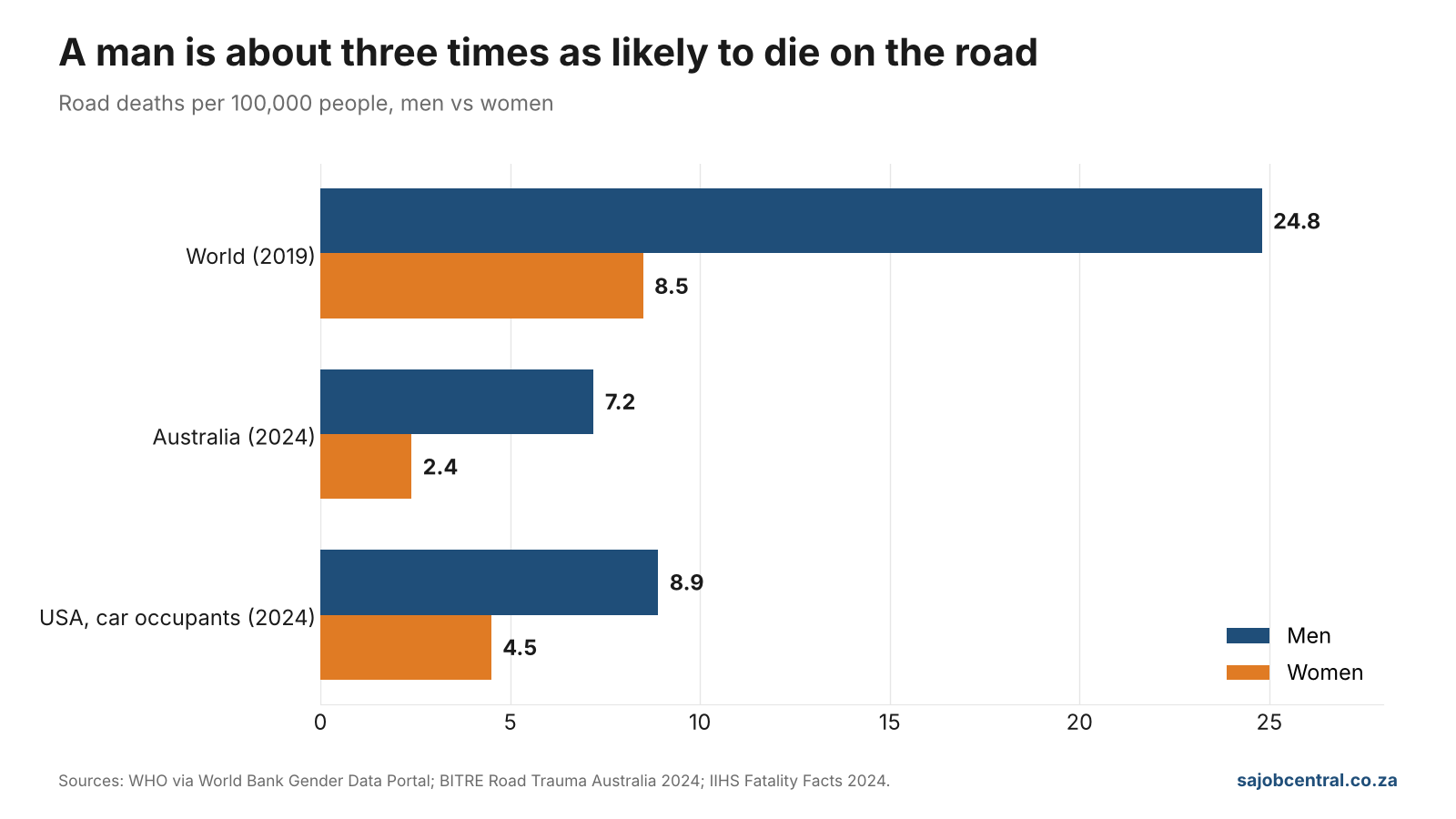
Men die on the roads far more often than women. The WHO says males are “typically 3 times more likely to be killed in road crashes than females.” The latest global estimates published by the World Bank, using WHO data for 2019, put the road death rate at 24.8 per 100,000 men against 8.5 per 100,000 women. That is almost exactly three to one.
Men are also involved in more serious crashes, even after you allow for the fact that they drive more kilometres than women. But the picture is not as simple as “women are better drivers”. When a woman is in a crash, there is evidence she can be more likely to be badly hurt, and some older studies found women have slightly more minor bumps per kilometre driven. We unpack all of that below.
Africa: the deadliest roads in the world
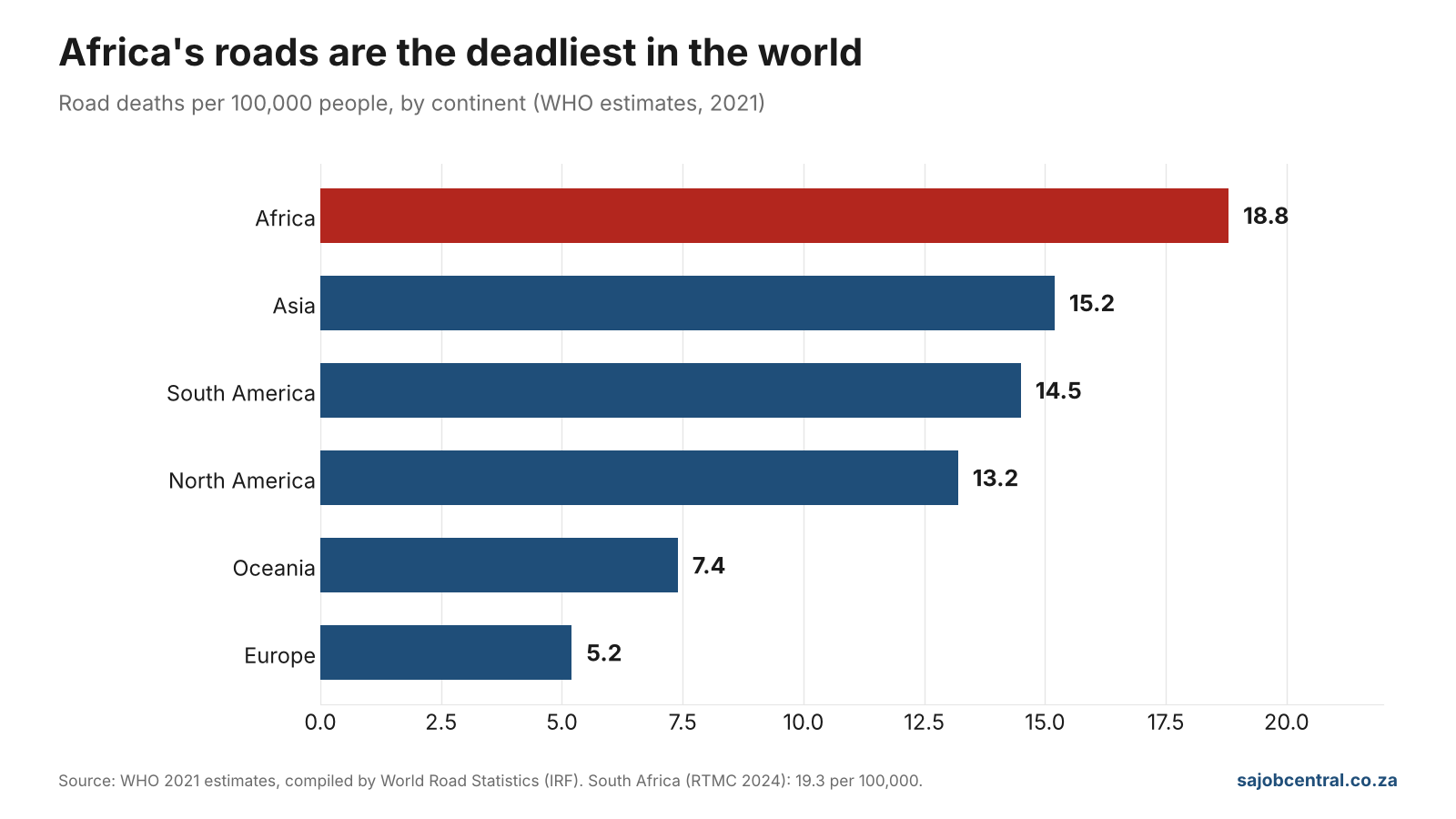
Africa has the highest road death rate of any continent. WHO estimates for 2021 put it at 18.8 deaths per 100,000 people, and the WHO’s African Region figure is even higher at 19.4, the worst in the world. The WHO says road death rates are highest in its African Region and lowest in Europe.
Worse, Africa is going the wrong way. While Europe cut road deaths by 36% and the Western Pacific by 15%, the WHO’s July 2026 update reported a 17% rise in deaths in the African Region.
South Africa
South Africa’s own figures paint the same picture. According to the RTMC’s State of Road Safety report for 2024:
- 12,172 people died on South African roads in 2024, up 2.43% from 11,883 in 2023.
- That works out to 19.32 deaths per 100,000 people, almost exactly the African average.
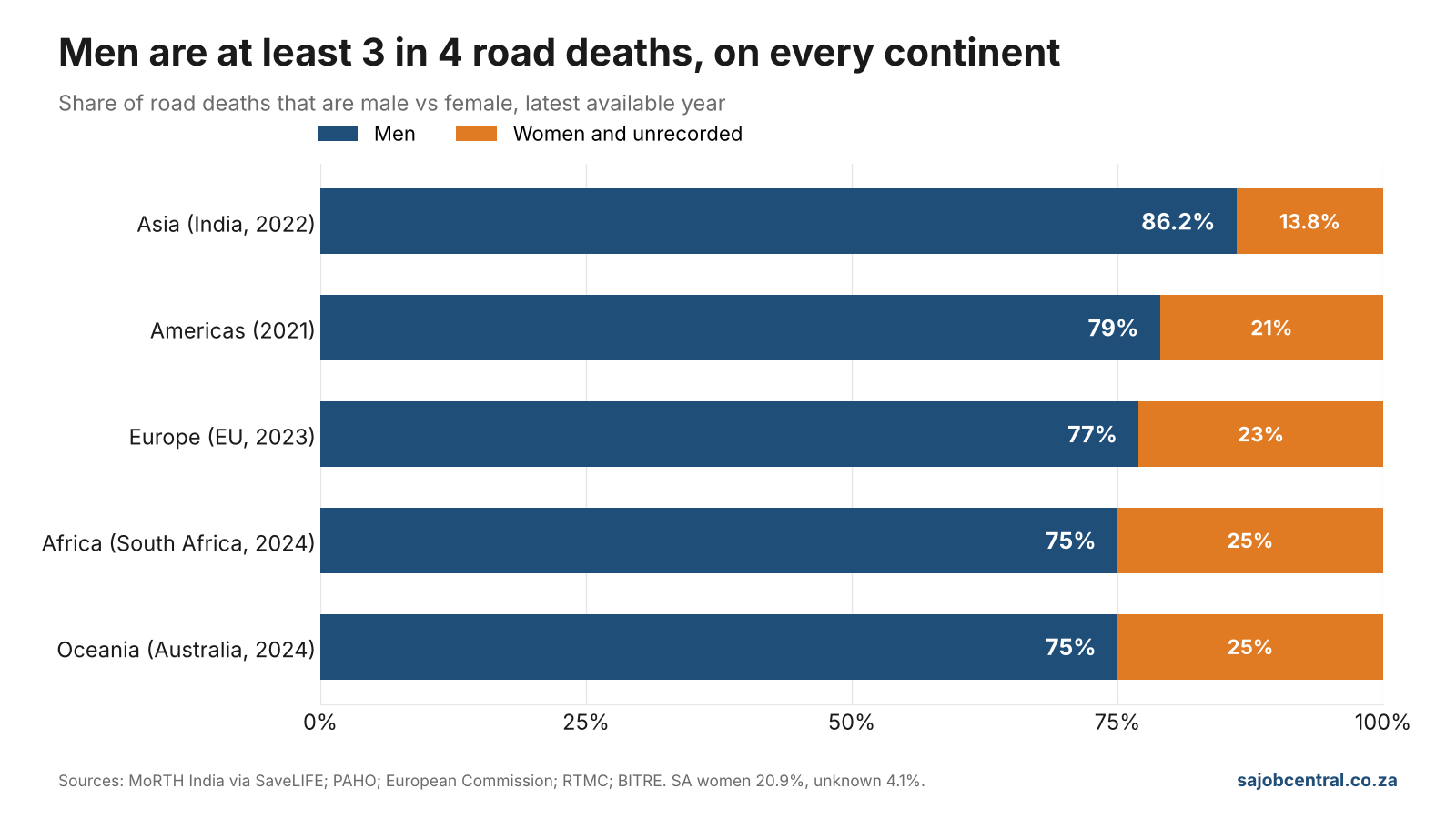
- About three quarters of the people killed (75.0%) were male. Women made up 20.9%, and in 4.1% of cases the sex was not recorded.
- Pedestrians were the biggest group, at about 45% of all deaths. Passengers made up 28.3%, drivers 25.7% and cyclists 1.2%.
- People aged 25 to 39 made up about 41% of deaths, and children under 15 made up 9.4%.
- Crashes cost the country an estimated R217.53 billion in 2024.
Here is a number that puts the gender gap into perspective. According to the same RTMC report, about 61% of licensed drivers on the national system are men and 39% are women. So men are over-represented among road deaths even compared to their share of drivers. And because so many of the dead are pedestrians and passengers, the gap is not only about who is holding the steering wheel.
Timing matters too. The RTMC found that 58% of pedestrian deaths happened between Friday and Sunday, and roughly a third of fatal crashes happened between 17:00 and 22:00. That is the time of day when people are tired, the light is fading and, on weekends, alcohol is more likely to be involved.
Kenya
Other African countries show an even bigger male share. Figures from Kenya’s National Transport and Safety Authority, published by The Star, show that between October and December 2024, 1,043 men and 163 women died on Kenyan roads. That means about 86% of the dead were male. In the same months of 2023 the split was 858 men to 185 women, or about 82% male.
Part of the reason is the boda boda. Motorcycle taxis are a huge source of work for young men in East Africa, and motorcyclists are among the most exposed road users anywhere. The WHO says deaths among motorcyclists now account for nearly a third of the world’s road deaths.
Asia: the most deaths, and the biggest gender gap
Asia has the largest number of road deaths simply because it has the most people. According to the WHO’s 2023 global report, the South-East Asia region accounts for 28% of the world’s road deaths and the Western Pacific for another 25%. Together that is more than half of all road deaths on earth. Asia’s death rate, at 15.2 per 100,000 in 2021, is second only to Africa’s.
India is the clearest example of how male the problem can be. Government figures for 2022, summarised by the SaveLIFE Foundation, show that 168,491 people were killed on Indian roads. Of those, 145,177 were men and 23,314 were women. That is 86.2% male and only 13.8% female, the biggest gap of any country in our sample.
Why so lopsided? In India, as in much of Asia, far more men than women ride motorcycles and scooters, drive for a living and travel long distances for work. Men are simply on the road more, and on the most dangerous kinds of vehicles.
Europe: the safest roads, the same pattern
Europe has the safest roads in the world, at 5.2 deaths per 100,000 people in 2021. The European Commission says about 19,800 people died on EU roads in 2024, down 3% on the year before.
But even on the safest roads, the gender split barely moves. In 2023, about 20,400 people died on EU roads and the Commission says men were 77% of them, “over three quarters”. In 2020 the split was 76% men and 22% women.
That tells us something important. Better roads, stricter enforcement and safer cars bring the total number of deaths down. They do not change who is dying. Men are still roughly three in four of the victims.
The Americas: 79% of the dead are men
According to the Pan American Health Organization (PAHO), 145,090 people died on the roads of North, Central and South America and the Caribbean in 2021. That is a rate of 14.09 per 100,000 people. PAHO says these deaths are “more common in men (79%)” and among young adults aged 18 to 44, who make up 54% of the dead.
Four countries, Brazil, Colombia, the United States and Mexico, account for 72% of the region’s road deaths. Motorcyclists make up 27% of deaths across the Americas, more than pedestrians at 17%.
The United States: the best data on why
The United States has some of the most detailed crash data in the world, and it helps explain why men die more. According to the Insurance Institute for Highway Safety (IIHS), using federal crash data:
- In 2024, 28,385 men and 10,764 women died in motor vehicle crashes in the US.
- Among people killed inside passenger vehicles, the death rate was 8.9 per 100,000 men against 4.5 per 100,000 women. The IIHS says male rates have been about twice as high as female rates every year since 1975.
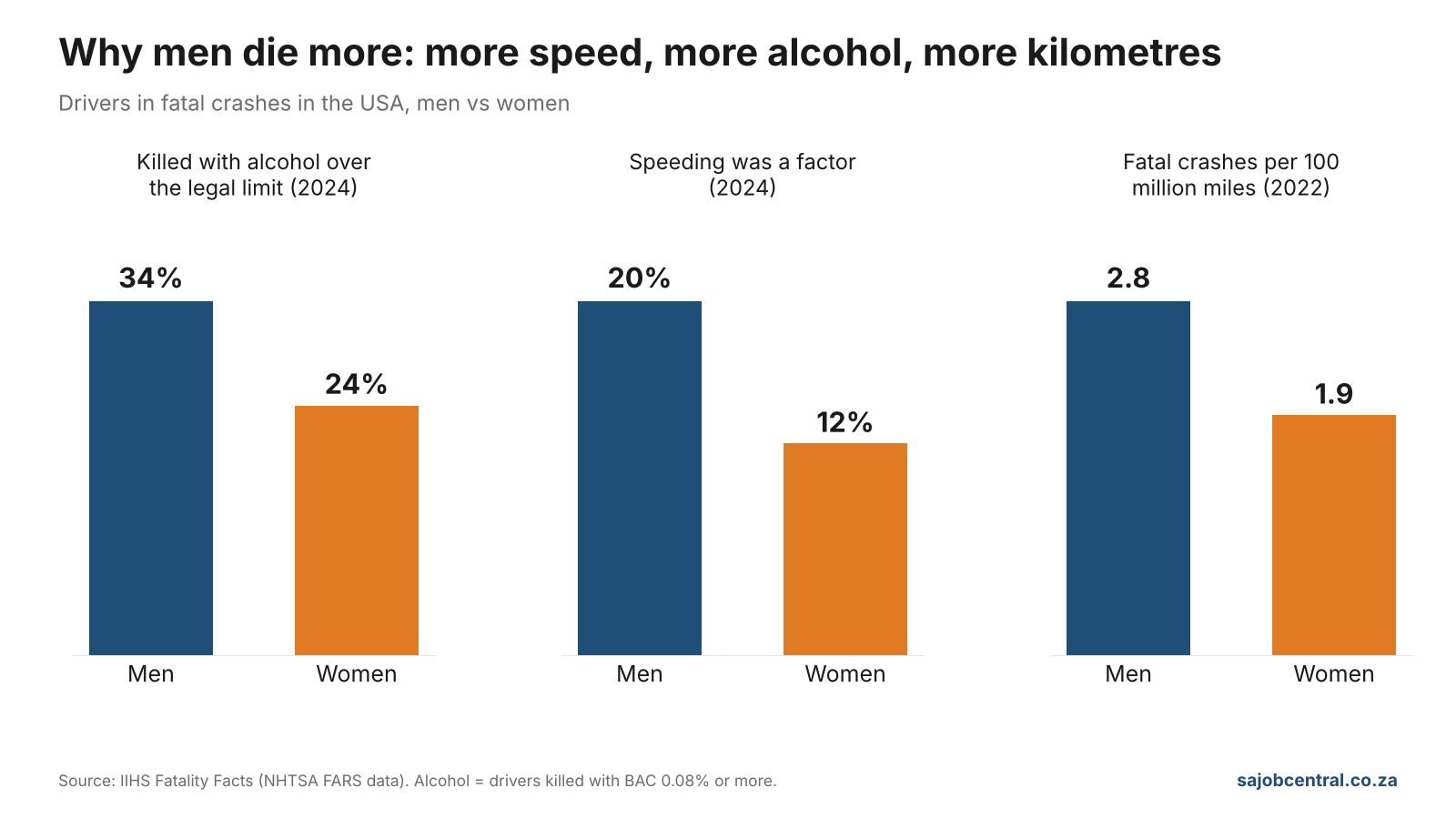
- Among drivers involved in fatal crashes in 2024, 20% of men were speeding, compared with 12% of women.
- Among drivers killed in crashes, 34% of men had a blood alcohol level of 0.08% or more, compared with 24% of women.
The IIHS also says men are more likely to take other risks behind the wheel, such as not wearing a seatbelt.
Oceania: Australia’s three-to-one split
Australia and New Zealand have some of the lowest road death rates outside Europe. Oceania as a whole had 7.4 deaths per 100,000 people in 2021.
Australia’s Bureau of Infrastructure and Transport Research Economics (BITRE) reports that 967 men and 328 women died on Australian roads in 2024. That is about 75% male. The death rate was 7.2 per 100,000 for men and 2.4 for women: once again, three to one.
“But men drive more.” Does that explain it?
It is the first thing people say, and it is partly true. Men do drive more kilometres than women in most countries. An Australian government study using 1995 data found men drove about 1.5 kilometres for every 1 kilometre women drove.
But distance does not explain the whole gap. When researchers divide crashes by the distance driven, men still come out worse for the serious ones:
- In the US in 2022, male drivers were involved in 2.8 fatal crashes for every 100 million miles they drove. For women it was 1.9. The IIHS says that makes the male rate 48% higher, mile for mile.
- The same Australian study found men had 0.76 deaths per 100 million kilometres driven, against 0.46 for women.
- A 2018 UK study in the Journal of Safety Research, which measured risk per trip, found male drivers had a higher risk of both fatal and non-fatal crashes.
So are women “better drivers”? Not quite that simple
On the numbers that matter most, deaths, women come out much better. But there are two twists that are worth knowing.
Twist one: minor crashes. The same Australian study that found men had more deaths per kilometre found women had slightly more hospital admissions per kilometre: 8.35 per 100 million kilometres for women against 7.35 for men. Women, in other words, may have more small crashes for the distance they drive, while men have more of the crashes that kill. That data is old, so treat it with caution, but it is a useful reminder that “fewer deaths” and “fewer crashes” are not the same thing.
Twist two: when women crash, they can be hurt worse. A 2021 IIHS study of real crashes from 1998 to 2015 found that, per crash, women were 20% to 28% more likely than men to be killed and 37% to 73% more likely to be seriously injured. Much of that gap came from the cars people were in and the kind of crash. About 70% of the women in crashes were in cars, while more than 20% of the men were in heavier pickups. When the researchers compared similar crashes in similar vehicles, most of the difference disappeared, though women were still about twice as likely to suffer moderate injuries, especially to the legs.
Many crash-test dummies have historically been modelled on an average male body. Safety campaigners argue that cars should be tested with dummies that better represent women, and that is now changing in some testing programmes.
Why are men dying more?
Across the reports we read, the same reasons keep coming up:
- Speed. The WHO says every 1% rise in average speed brings a 4% rise in the risk of a fatal crash. Men are more likely to speed.
- Alcohol. Men are more likely to drive or walk drunk. In South Africa, weekends and evenings are the deadliest times on the road.
- Seatbelts. The WHO says wearing a seatbelt can cut the risk of death for vehicle occupants by up to 50%. Men are less likely to buckle up.
- Exposure. Men make up most of the truck, taxi, bus and delivery drivers, and most motorcycle riders. They spend more hours on the road, and much of it at night.
- Risk-taking. Young men in particular are more likely to take chances, from overtaking on a blind rise to using a phone while driving. The WHO says drivers using mobile phones are about four times more likely to crash.
What it means for South Africa
For South Africa, the lesson is uncomfortable but clear. Our roads kill at an African rate, around 19 people per 100,000 each year, nearly four times the European rate. Three quarters of those who die are men, most of them in the prime working ages of 25 to 39.
That is not only a personal tragedy for families. It is a loss of breadwinners, fathers, sons and workers, and it costs the economy more than R200 billion a year. The WHO estimates road crashes cost most countries about 3% of their GDP.
And because 45% of South Africa’s road deaths are pedestrians, many of the victims are not driving at all. They are people walking home, often in the dark, often on roads with no pavements or street lights.
How to stay safe, whoever you are
- Buckle up, front and back, on every trip. It can halve your risk of dying in a crash.
- Slow down. Even a small cut in speed makes a big difference to whether a crash is deadly.
- Never drive after drinking. Get a lift, use an e-hailing app or stay over.
- Put the phone away. A message can wait.
- If you’re walking at night, wear something light or reflective and use pedestrian crossings and bridges where there are any.
- Take extra care on Friday to Sunday evenings, when the RTMC says South Africa’s roads are at their most dangerous.
- If you ride a motorbike, wear a proper helmet. The WHO says a good helmet cuts the risk of death by more than six times.
The bottom line
On every continent we looked at, men are at least three out of every four people who die on the roads. That is true on Africa’s dangerous highways and on Europe’s safe ones. Men drive more, but even kilometre for kilometre they are involved in more of the crashes that kill, largely because of speed, alcohol and risk-taking.
Women are not immune. When they do crash, they can be more likely to be seriously hurt, and safer car design still has work to do for them. But if you want to know who is filling the statistics, the answer is the same in Johannesburg, Nairobi, Delhi, São Paulo, Berlin and Sydney: men.
Sources: WHO road traffic injuries fact sheet (July 2026); WHO news release (July 2026); WHO Global status report on road safety 2023; RTMC State of Road Safety 2024; World Road Statistics; European Commission; PAHO; IIHS Fatality Facts; IIHS (2021); BITRE Road Trauma Australia 2024; SaveLIFE Foundation; The Star (Kenya); Australian Federal Office of Road Safety (1998); World Bank Gender Data Portal.